The challenges facing PET bottle recycling in Hong Kong
Hong Kong has the ingredients for effective PET bottle recycling: strong public awareness, established collection points, and growing interest from brands and consumers alike. Yet the system still struggles to perform at the level many people expect.
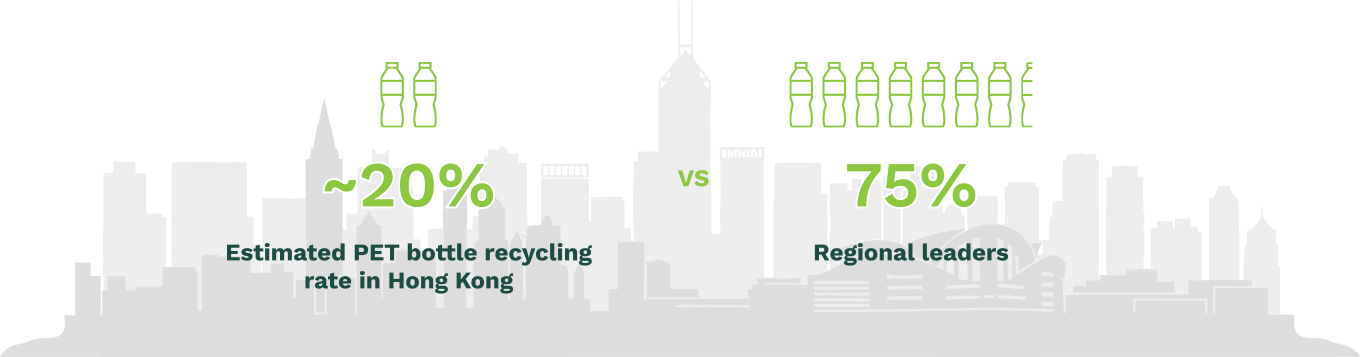
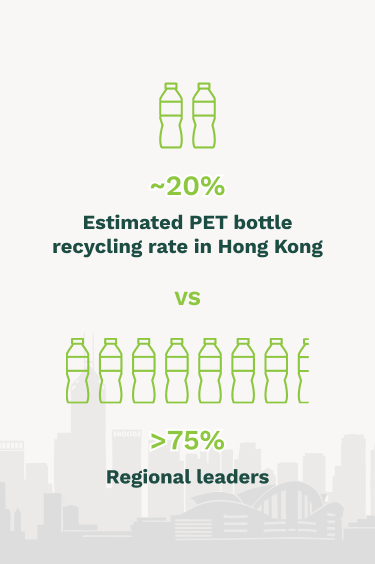
At present, Hong Kong’s PET bottle recycling rate is estimated at around 20%, well behind regional leaders that achieve over 75%. The reasons are not down to one single issue. They sit across three connected areas: policy and economics, collection and logistics, and material quality.
While the Government is moving towards a Producer Responsibility Scheme (PRS) for plastic beverage containers (currently expected to take effect in 2028), there are real, immediate hurdles that need addressing—especially around funding and the quality of collected materials.
Recycling systems do not run on goodwill alone; they need clear rules and steady funding.
No waste charging (yet)
Without a Municipal Solid Waste (MSW) charging scheme, there is little financial reason for residents or businesses to separate or sort bottles properly rather than sending them straight to landfill.
Limited producer accountability
In the absence of a fully implemented PRS today, there is no consistent mechanism to fund with the ultimate aim of collection and processing at the scale required—so too many bottles still end up as waste.
Low system performance
These gaps contribute to the current low recycling rate compared with nearby markets that have stronger policy levers and targets.
What is changing
The Government is taking steps to close this gap. The PRS on Plastic Beverage Containers and Beverage Cartons is anticipated to pass the Legislative Council by 2026 and come into effect in 2028, with the aim of reaching a recycling rate above 75%.
No waste charging (yet)
Without a Municipal Solid Waste (MSW) charging scheme, there is little financial reason for residents or businesses to separate bottles properly rather than sending them straight to landfill.
Limited producer accountability
In the absence of a fully implemented PRS today, there is no consistent mechanism to fund collection and processing at the scale required—so too many bottles still end up as waste.
Low system performance
These gaps contribute to the current low recycling rate compared with nearby markets that have stronger policy levers and targets.
What is changing
The Government is taking steps to close this gap. The PRS on Plastic Beverage Containers and Beverage Cartons is anticipated to pass the Legislative Council by 2026 and come into effect in 2028, with the aim of reaching a recycling rate above 75%.
Even with good intentions, collecting clean, usable bottles across Hong Kong is demanding.
A high-cost operating environment
Hong Kong’s dense, fast-moving cityscape makes collection and transport more complex and more expensive than in many other places. In particular, space is at a premium, making it difficult to store waste, leading to more frequent and higher cost logistics
Inconsistent sorting at source
Public recycling bins are widely available, but sorting accuracy varies. When bottles are mixed with the wrong items, the whole stream suffers.
A fragmented collection network
Collection arrangements differ between housing estates, commercial districts, public spaces and schools, making it harder to build a consistent, citywide system.
Contamination is a major issue
PET bottles often arrive with liquid, food residue, or mixed plastics (such as HDPE or PVC). High contamination raises washing and sorting costs—and in some cases can lead to loads being rejected altogether.
Even with bottles are collected, the quality of what comes in determines what can be made from it
Limited shared guidance on “recyclable” packaging
Without clear, widely understood standards—and the public education to match—people are left guessing, which leads to both contamination and recyclable items being thrown away.
Complex packaging design
Packaging is often designed for shelf impact, not recycling. Sleeves, adhesives, and mixed materials can make automated sorting much harder.
Problem materials that undermine recycling value
PVC labels are particularly harmful. During hot washing, PVC can break down and damage equipment and final product quality.
Coloured PET mixed with clear PET reduces what the material can be used for. Once colours are mixed, it is far harder to produce high-quality clear rPET, which lowers the value of the recycled material.The shortage of long-term leases in lower-cost industrial areas poses a particular challenge for recyclers in Hong Kong.
Funding for infrastructure remains a challenge
Advanced sorting and processing require sustained investment. A robust PRS is widely seen as a key way to provide stable funding for the facilities and systems needed.